
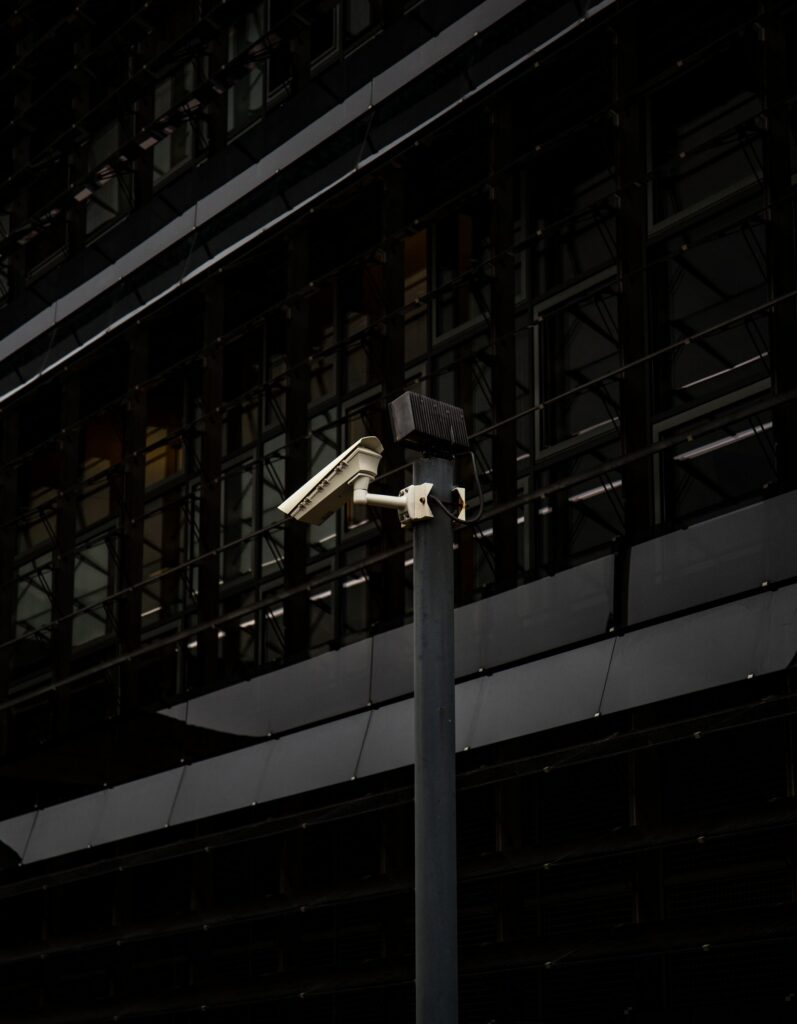
Monitoring an outdoor area does not simply mean installing a camera aimed at an entrance. Distance, field of view, back‑lighting, night illumination and the presence of moving elements affect image quality. The network and recording management also impact the ability to review the material in a useful and responsible way. The scene must be observed under actual conditions.
The demonstrative project concerns entrances, perimeter and operational areas of a professional building. The goal is to obtain images consistent with a declared purpose, avoiding recordings that are broader than necessary and organizing access so that review remains limited to authorized personnel.
The need
Outdoor areas are traversed under varying lighting conditions and contain points where people and vehicles move at different distances. A single very wide shot could provide an overall view, but not necessarily the detail needed to understand an event. Conversely, too many recordings would make management more complex and could include irrelevant spaces.
Therefore it is necessary to define what must be observed, at which times and with what level of detail. Retention periods, access roles and export methods must also be evaluated, respecting the responsibilities of the system owner and the principles applicable to data protection.
The designed solution
The site survey is used to simulate shots and check for obstacles, lighting and paths. Each recording point is linked to a concrete purpose. Optics, mounting and performance are chosen based on the real scene, rather than relying solely on the resolution listed in the technical sheet.
Recording and network capacity are sized considering the number of streams, expected quality and required continuity. Users are configured by role, limiting functions to authorized persons. If the project includes an alarm or access‑control integration, the events to be coordinated are defined before installation, with a clear separation between the different functions.
During commissioning, images are tested under the available conditions and visualization, search and recording management are checked. The tests also serve to correct shots that are too wide or illegible before handover.
A system designed for everyday use
Consultation must be simple without becoming indiscriminate. Responsible personnel receive guidance on the agreed procedures, while credentials and authorizations are organized so that each system access corresponds to a responsibility. An orderly configuration reduces the risk of important functions remaining unused or images being managed inconsistently.
Over time lighting, vegetation, outdoor furniture or routes may change. A periodic check of the framing helps keep the system aligned with the original purpose. Any expansions should also start from the same question: what information must the new recording provide?
To evaluate a video solution it is useful to describe areas and events to be observed, so as to set tests and responsibilities before choosing the equipment.